|
Ellen G. White, the
prophet of the Seventh-day Adventist Church
believed in a false Christ who was given an
exalted position by the Father after He was
created. In her view, Jesus was a
lesser god, a created god. She and the other
founders of the Seventh-day Adventist Church
were all Arian cultists who taught the
heretical belief that Christ was a created being who
God the Father invested with divinity after
His creation.
Ellen
White had this to say about Christ’s nature:
“To Christ has
been given an exalted position.
He has been
made equal with the Father.” [Testimonies
for the Church, Vol. 8, p. 268].
“Satan in
Heaven, before his rebellion, was a high and
exalted angel, next in honor to God’s dear
Son. His countenance, like those of the
other angels, was mild and expressive of
happiness. His forehead was high and broad,
showing a powerful intellect. His form was
perfect; his bearing noble and majestic. A
special light beamed in his countenance, and
shone around him brighter and more beautiful
than around the other angels; yet Jesus,
God’s dear Son, had the pre-eminence over
all the angelic host. He was one with the
Father before the angels were created. Satan
was envious of Christ, and gradually assumed
command which devolved on Christ alone.
The great Creator
assembled the heavenly host, that he might
in the presence of all the angels
confer
special honor upon his Son…
The Father then
made known that it was ordained by himself
that Christ,
his Son,
should be equal
with himself; so that wherever was
the presence of his Son, it was as his own
presence. The word of the Son was to be
obeyed as readily as the word of the Father.
His Son he had
invested with authority to command the
heavenly host. Especially was his Son
to work in union with himself in the
anticipated creation of the earth and every
living thing that should exist upon the
earth. His Son would carry out his will and
his purposes, but would do nothing of
himself alone. The Father’s will would be
fulfilled in him.” [Spirit of Prophecy, Vol. 1, pp.
17-18].
“The
exaltation of the Son of God as equal with
the Father was represented as an
injustice to Lucifer, who, it was claimed,
was also entitled to reverence and honor.”
[Patriarchs and Prophets, p. 37].
“The spirit of dissatisfaction thus kindled
[by Lucifer] was doing its baleful
work. While there was no open outbreak,
division of feeling imperceptibly grew up
among the angels. There were some who looked
with favor upon Lucifer’s insinuations
against the government of God. Although they
had heretofore been in perfect harmony with
the order which God had established, they
were now discontented and unhappy because
they could not penetrate His unsearchable
counsels; they
were dissatisfied with His purpose in
exalting Christ. These stood ready to second
Lucifer’s demand for equal authority with
the Son of God.” [ibid,
p. 38].
The Great Controversy
Theme:
Ellen White concocted the
fanciful story about the fall of Lucifer and
the angels who followed him into what
Seventh-day Adventists call, “the Great
Controversy theme.” In this story,
Adventists believe they have a God-given
understanding about the mystery behind the
scriptures as to why there is war in heaven
and it all centers around Satan’s anger over
the exaltation of Christ to His divine
status. The entire Seventh-day Adventist
worldview is founded on the belief that
Christ had to be invested with divine rights
by the Father and given his preeminent place
above all other created things.
In 1871, Ellen G. White proved she
didn’t understand, or believe in the
Trinity.
“The simple language of the Scriptures
represent the Father and Son as two distinct
persons. With this view of the subject there
are meaning and force to language which
speaks of the Father and the Son.
But to say that
Jesus Christ “is the very and eternal God,”
makes him his own
son, and his own father,
and that he came
from himself,
and went to
himself. And when the Father sends
Jesus Christ, whom the Heavens must receive
till the times of restitution, it will
simply be Jesus Christ, or the eternal
Father sending himself.
We have not as
much sympathy with Unitarians that deny the
divinity of Christ,
as with
Trinitarians who hold that the Son is the
eternal Father,
and talk so
mistily about the three-one God. Give
the Master all that divinity with which the
Holy Scriptures clothe him.” [Review and
Herald, June 6, 1871, p. 197].
Seventh-day Adventists
will say that Ellen White’s later writings were
Trinitarian. Not so!
Ellen
White’s husband, James White was an
out-spoken anti-Trinitarian until the day
he died and Ellen White never spoke out
against her husband’s heretical beliefs as long as he
lived. Ellen White made a number of
conflicting statements as she got older
about the nature of God, Jesus’ divine nature, and
the Holy Spirit, and she seemed to be moving
more towards a Trinitarian view, but she
continued to have many misconceptions about
Jesus’ true nature.
In 1897, Ellen
White said this about Christ’s divine nature,
“In Him was life original, unborrowed,
underived.” [Desire of Ages, p. 530] And, “He was equal with God, infinite and
omnipotent.” [MS 101, 1897].
That sounds
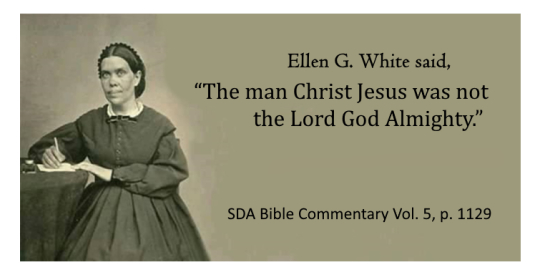
Trinitarian, but later in 1903 she made her now
famous statement,
“There is no one who can explain the mystery
of the incarnation of Christ. Yet we know
that He came to this earth and lived as a
man among men.
The man Christ Jesus was not the Lord God
Almighty, yet Christ and the Father
are one.” [MS 140, 1903; SDA Bible Commentary,
Vol. 5, p. 1129].
Seventh-day Adventists will say we are
taking her out of context, but the very next year in 1904, she again said,
“God
is the Father of Christ; Christ is the Son
of God. To
Christ has been given an exalted position.
He has been made
equal with the Father. All the
counsels of God are opened to His Son.”
[Testimonies for the Church, Vol. 8, p. 268].
Ellen White consistently
taught that Christ was a created being who
God the Father elevated to his position of deity.
These are not the words of a true Trinitarian, or
a true prophet of God.
God
did not create Jesus and then elevate him to
a position of divinity like so many of the
cults teach today. God the Father did not
have to invest the Son
with divine characteristics at some point in time after He
was
created, He has always existed as the
eternal God and one with the Father. Jesus
is not a created being!
There is only one
God.
Deuteronomy 6:4 says, “Hear, O
Israel: The LORD our God, the LORD is one.”
You cannot be God
and not be fully God (Isa. 43:10-12; 44:6-8).
And you cannot be the
mighty God and not be the Almighty God (Isa. 9:6).
Ellen White was a cultist as were the
other founders of the Seventh-day Adventist
Church who taught the Arian heresy. Ellen
taught a false god and a false Jesus
right up until the day she died!!
Now let’s look at some
of the most important passages of scripture
relating to Christ’s divinity:
Jesus
Christ, the Son of God,
took upon Himself our human nature to be the perfect sacrifice
for our sins.
1 Peter 1:18-19 says, “knowing that
you were not redeemed with perishable things
like silver or gold from your futile way of
life inherited from your forefathers, but
with precious blood, as of a lamb
unblemished and spotless, the blood of
Christ.”
1 Peter 2:21-22 says,
“For to this you have been called, because
Christ also suffered for you, leaving you an
example, so that you might follow in His
steps. He committed no sin, neither was
deceit found in His mouth.”
Hebrews 4:14
says, “For we do not have a High Priest
who cannot sympathize with our weaknesses,
but one who in every respect has been
tempted as we are, yet without sin.”
2 Corinthians 5:21 says, “He made Him
who knew no sin to be sin on our behalf, so
that we might become the righteousness of
God in Him.”
And 1 John 3:5 says,
“And you know that He was manifested to take
away our sins, and in Him there is no sin.”
“Jesus appeared to take away sins, not
only so that sin might be forgiven (1 Jn. 1:9),
but also so that it might cease to
exercise its tyrannical bondage. In him
there is no sin. A reminder that “God is
light” (1 Jn. 1:5), and his Son embodies his
sinlessness.” [1]
Jesus Christ was God in human
flesh.
Jesus taught His disciples to pray in His name
(John 16:23-24). He claimed that He and the
Father were one, and that He was the one and
only, preexistent Son of
God (John 3:16; 10:30, 36; 14:9; 17:11). He
claimed that to know Him was to know God; to
see Him was to see God; to receive Him was
to receive God; to believe Him was to
believe in God; to honor Him was to
honor God; and to hate Him was to hate God
(John 8:18; 14:7; 12:45; 14:9; Mark 9:37;
John 5:23; 12:44; 14:1; 15:23).
[2]
Jesus Christ is called our great
God and Savior:
Titus
2:11-14 says, “For the grace of God has
appeared, bringing salvation for all people,
training us to renounce ungodliness and
worldly passions, and to live
self-controlled, upright, and godly lives in
the present age, waiting for our blessed
hope, the appearing of the glory of our
great God and Savior Jesus Christ, who gave
himself for us to redeem us from all
lawlessness and to purify for himself a
people for his own possession who are
zealous for good works.” (see: Isa.
45:21-22)
Likewise, 2 Peter 1:1-2
says, “Simeon Peter, a servant and apostle
of Jesus Christ, To those who have obtained
a faith of equal standing with ours by the
righteousness of our God and Savior Jesus
Christ. May grace and peace be multiplied to
you in the knowledge of God and of Jesus our
Lord.”
In both Titus 2:13 and 2 Peter
1:1, Jesus is called “God and Savior,”
making these passages two of the clearest
declarations in the New Testament of
Christ’s divinity.
The
Granville Sharp rule:
“The
terms “God and Savior” both refer to the
same person, Jesus Christ. This is one of
the clearest statements in the NT concerning
the deity of Christ. The construction in
Greek is known as the Granville Sharp rule,
named after the English
philanthropist-linguist who first clearly
articulated the rule in 1798. Sharp pointed
out that in the construction article-noun-καί-noun
(where καί [kai] = “and”),
when two nouns are singular, personal, and
common (i.e., not proper names), they always
had the same referent. Illustrations such as
“the friend and brother,” “the God and
Father,” etc. abound in the NT to prove
Sharp’s point.” [3]
Listen to how the
Apostle Paul describes Christ’s humility
and exaltation in coming to earth to be our
savior:
Philippians 2:5-11
says; “Let this mind be in you which was
also in Christ Jesus: Who, existing in the
form of God, did not consider equality with
God something to be grasped, but emptied
Himself, taking the form of a servant, being
made in human likeness. And being found in
appearance as a man, He humbled Himself and
became obedient to death—even death on a
cross. Therefore God exalted Him to the
highest place and gave Him the name above
all names, that at the name of Jesus every
knee should bow, in heaven and on earth and
under the earth, and every tongue confess
that Jesus Christ is Lord, to the glory of
God the Father.” (BSB)
The Life
Application Study Bible says this about the
sacrifice Christ made for us when He came to
earth.
“The Incarnation was the act of the
preexistent Son of God voluntarily assuming
a human body and human nature. Without
ceasing to be God, he became a human being,
the man called Jesus. He did not give up his
deity to become human, but he set aside the
right to his glory and power. In submission
to the Father’s will, Christ limited his
power and knowledge. Jesus of Nazareth was
subject to place, time, and many other human
limitations. What made his humanity unique
was his freedom from sin. In his full
humanity, Jesus showed us everything about
God’s character that can be conveyed in
human terms.” [4]
The MacArthur Study Bible
has this to say about Philippians 2:6. Jesus “existed in the
form of God.” Paul affirms that Jesus eternally has been God. The usual Greek
word for “existed” or “being” is not used here. Instead, Paul chose another term
that stresses the essence of a person’s nature—his continuous state or
condition. Paul also could have chosen one of two Greek words for “form,” but he
chose the one that specifically denotes the essential, unchanging character of
something—what it is in and of itself. The fundamental doctrine of Christ’s
deity has always encompassed these crucial characteristics (cf.
John 1:1, 3, 4, 14; 8:58; Col. 1:15-17; Heb. 1:3).”
And the Nelson’s NKJV Study Bible says this, “The Greek word for form was
generally used to express the way in which a thing exists and appears according
to what it is in itself. Thus, the expression form of God may be correctly
understood as the essential nature and character of God. To say, therefore, that
Christ existed in the form of God is to say that apart from His human nature
Christ possesses all the characteristics and qualities belonging to God because
He is, in fact, God.”
Jesus Christ is the God who spoke the universe into
existence:
John 1:1-3 says, “In the beginning was
the Word, and the Word was with God, and the
Word was God. He was in the beginning with
God. All things were made through him, and
without him was not any thing made that was
made.”
The Apostle John starts out
his gospel by alluding to the creation in
the book of Genesis. “Genesis 1:1 starts with the
moment of creation and moves forward to the
creation of humanity. John 1:1 starts with
creation and contemplates eternity past...
God the Father created the world (Gen. 1:1)
through God the Son (Col. 1:16; Heb. 1:2).
All creation was made through Him. Thus He
is the Creator God.”
[5]
All things were created through
Christ and for Him:
Colossians 1:15-20 says, “He is the image of
the invisible God, the firstborn of all
creation. For by him all things were
created, in heaven and on earth, visible and
invisible, whether thrones or dominions or
rulers or authorities—all things were
created through him and for him. And he is
before all things, and in him all things
hold together. And he is the head of the
body, the church. He is the beginning, the
firstborn from the dead, that in everything
he might be preeminent. For in him all the
fullness of God was pleased to dwell, and
through him to reconcile to himself all
things, whether on earth or in heaven,
making peace by the blood of his cross.”
The word
“firstborn” in Colossians 1:15 is from the Greek word
“prototokos” which indicates that “the historic
Jesus was none other than the preexistent
Christ, who is coeternal with the Father.
The terminology “firstborn” is a reference
to priority of position. It is a term that
emphasizes quality or kind, not time. The
idea of “preeminence” conveys the meaning of
the term.” [6]
Regarding Christ’s divine nature, the
MacArthur Study Bible says this about
Colossians 1:15, “it is impossible for
Christ to be both created, and the Creator
of everything (Col. 1:16). Thus Jesus is the
firstborn in the sense that He has the
preeminence (Col. 1:18) and possesses the
right of inheritance over “all creation”
(cf. Heb. 1:2; Rev. 5:1-7, 13). He existed
before the creation and is exalted in rank
above it.”
Jesus Christ called Himself the “Alpha and Omega” in the book of
Revelation.
Revelation 1:7-8 says
of Jesus, “Behold,
he is coming with the
clouds, and every eye will see him, even
those who pierced him, and all tribes of the
earth will wail on account of him. Even so.
Amen. “I am the Alpha and the Omega,”
says
the Lord God, “who is and who was and who is
to come, the Almighty.”
Revelation 1:17-18
says, “When I saw him, I fell at his
feet as though dead. But he laid his right
hand on me, saying, “Fear not,
I am the
first and the last,
and the living one.
I died,
and behold I am alive forevermore, and
I have the keys of Death and Hades.”
Jesus Christ affirmed His divinity
in Revelation 1:17-18 and boldly claimed to be God
when He applied
the Old Testament name for Israel’s God,
Yahweh to Himself (Rev. 22:13; cf. Isa. 41:4; 44:6; 48:12; John 8:58).
Revelation 21:6 says, “And he said to me,
“It is done! I am the Alpha and the Omega,
the beginning and the end. To the thirsty I
will give from the spring of the water of
life without payment.” (cf. Matt. 11:28-30;
John 4:14; 7:38).
And in
Revelation 22:12-13 Jesus said, “Behold,
I
am coming soon, bringing my recompense with
me, to repay each one for what he has done.
I am the Alpha and the Omega,
the first and
the last, the beginning and the end.”
“Once again Christ is described as the
Alpha and the Omega (first and last letters
of the Greek alphabet), the First and the
Last, the Beginning and the End. Christ is
before all Creation and He will continue to
exist after the present creation is
destroyed. He is the Eternal One (cf.
Rev. 1:4, 8, 17; 2:8; 21:6).”
[7]
Jesus accepted people’s worship:
If Jesus was just a good, holy man, and
not God, He would have rebuked people for
worshipping Him, but Thomas called him, “My
Lord and my God” in John 20:28, and Jesus
did not correct him. Jesus never rebuked
anyone for worshiping Him (Matt. 2:11;
14:33; 28:9, 17; Luke 24:52; John 9:38). If
Jesus was a created being he would have
rejected man’s worship just as the holy
angels do in Revelation 19:10; 22:8-9.
The scriptures refer to Jesus as
God many times:
Romans 9:5
says, “To them belong the patriarchs, and
from their race, according to the flesh, is
the Christ, who is God over all, blessed
forever. Amen.”
And Colossians 2:8-10
says, “See to it that no one takes you
captive by philosophy and empty deceit,
according to human tradition, according to
the elemental spirits of the world, and not
according to Christ. For in him the whole
fullness of deity dwells bodily, and you
have been filled in him, who is the head of
all rule and authority.”
The Jewish
leaders wanted to kill Jesus for claiming to
be God.
In
John 10:30 Jesus said, “I and the Father are one.”
The
Jews knew Jesus was claiming to be God
because they tried to stone Him for
blasphemy a few verses later. John 10:33
says, “The Jews answered him, “It is not for
a good work that we are going to stone you
but for blasphemy, because you, being a man,
make yourself God.”
Jesus was saying that He and the Father are
of the same divine nature and essence. A
statement that would have been blasphemous
and worthy of the death penalty if it were
not true.
Finally, the Father called Jesus
“God”
and said He was the greatest revelation of God to
man:
Hebrews 1:1-3
says, “Long ago, at many times and in many
ways, God spoke to our fathers by the
prophets, but in these last days he has
spoken to us by his Son, whom he appointed
the heir of all things, through whom also he
created the world. He is the radiance of the
glory of God and the exact imprint of his
nature, and he upholds the universe by the
word of his power. After making purification
for sins, he sat down at the right hand of
the Majesty on high.”
And Hebrews 1:8-9
goes on to say, “But of the Son he
says, “Your throne, O God, is forever and
ever, the scepter of uprightness is the
scepter of your kingdom. You have loved
righteousness and hated wickedness;
therefore God, your God, has anointed you
with the oil of gladness beyond your
companions.”
According to
the book of Hebrews, “Not only is
Jesus the exact representation of God, but
he is God himself—the very God who spoke in
Old Testament times. He is eternal; he
worked with the Father in creating the world
(John 1:3; Col. 1:16). He is the full
revelation of God. You can have no clearer
view of God than by looking at Christ. Jesus
Christ is the complete expression of God in
a human body.” [8]
Now look at how Ellen G. White
deliberately twisted the words of scripture to describe her work as God’s
last-day messenger.
“In
ancient times God spoke to men by the mouth
of prophets and apostles. In these days he
speaks to them by the testimonies of his
Spirit [her writings]. There was
never a time when God instructed his people
more earnestly than he instructs them now
concerning his will and the course that he
would have them pursue.” [Testimonies for
the Church, Vol. 5, p. 661].
It is
hard to believe how arrogantly Ellen G. White claimed that she, not Jesus, was
God’s final revelation to mankind.
Jesus Christ, not Ellen G. White, is the
final and greatest revelation of God because
He is God’s one and only Son. He is the
agent of creation, and the exact imprint of
his Father’s nature (Heb. 1:1-3).
Ellen G.
White’s false claims were the worst form of heresy. She never missed an opportunity
to make herself look like a true prophet of
God, but the truth
is, she was nothing more than a false prophet who
consistently taught a false Christ, and a
false gospel of works-righteousness.
Ellen G. White said that we had
to either believe everything she said was
from God, or none of it was.
“I am
presenting to you what the Lord has
presented to me. I do not write one article
in the paper expressing merely my own ideas,
they are what God has opened before me in
vision- precious rays of light shining from
the throne.” [Testimonies for the Church
Vol. 5, p. 67].
“The visions are either of God or the devil.
There is no half-way position to be taken in
the matter. God does not work in partnership
with Satan.” [Letter 8, 1860, pp. 16, 17, to
Brother John Andrews, June 11, 1860. 1MR
307.1].
Ellen G. White even
claimed that her testimonies were infallible
and said that those people who reject her gift
of prophecy are in rebellion against God.
“If you lessen the confidence of God’s
people in the testimonies He has sent them,
you are rebelling against God as were Korah,
Dathan, and Abiram.” [Testimonies for the
Church, Vol. 5, p. 66].
Contrary to what Ellen G. White taught,
the scriptures clearly teach that Jesus
Christ was God in the flesh, the Almighty
God, and not a created being.
Ellen White had a
diminished view of Jesus as God, and taught contradictory
concepts about Christ’s divine nature
throughout her entire life. She never once
spoke out against her husband’s heretical
Arian beliefs about God as long as he lived.
If Ellen White was a true prophet of God she
would have understood Jesus Christ’s true
nature from the very beginning of her ministry
and spoken out boldly against the
Arian heresy so prevalent in the early days
of the
Adventist Church.
Just like the
Jehovah’s Witnesses, Ellen White and the
early Seventh-day Adventist founders were
all Arian cultists. All the evidence proves
Ellen White consistently taught a false god, and a false
Jesus throughout her entire life!
We live in an age when false teachers
abound.
False prophets,
false miracle workers, and false gospels are
all competing for God’s people and we have
to do whatever we can to protect the body of
Christ against them. God has warned us! The last
thing any Christian should ever want to do
is lead another person into a false
religious system, their eternal destinies are at
stake.
The Seventh-day Adventist
Church does not deny their Arian
heritage. Who are you going to follow,
the false beliefs of the
Seventh-day Adventist Church and their
prophet, Ellen G. White, or the Bible? Both
cannot be true. [9]
For further study:
Jesus is referred to as God many times in
the New Testament:
(Matt. 3:16-17; John 1:1-18; 8:58-59; 10:30; 20:28;
Rom. 9:5; Phil. 2:5-8; 2:9-11; Col. 1:16-19; 2:9-10;
1 Tim. 6:15; Titus 2:11-13; Heb. 1:3, 8; 13:8; 2 Pet. 1:1;
1 Jn. 5:20; Rev. 1:8, 17; 2:8; 17:14; 19:16; 21:6; 22:13).
And, the Bible ascribes all
of the divine characteristics of God to
Jesus Christ. He is
described as eternal
(Isa. 9:6; Mic. 5:2;
John 1:1-2; 8:58; 17:5, 24; Col. 1:15-17;
1 Jn. 1:1; Rev. 1:8); omnipresent (Matt. 18:20; 28:20;
John 3:13); omniscient (John 2:24-25; 16:30; 21:17; Rev. 2:23);
omnipotent (Isa. 9:6; Phil. 3:21; Rev. 1:8;
cf. John 5:17; Heb. 1:3; Matt. 28:18) and
immutable (Heb. 1:10-12; 13:8).
References:
1. The ESV Study Bible:
1 John 3:5.
2. See:
Deity of Jesus Christ | Moody Bible
Institute
3. See: The NET Bible, text
notes on Titus 2:13 and 2 Peter 1:1
4. The Life
Application Study Bible: Philippians 2:5-7.
5. The Nelson’s NKJV Study Bible: John 1:1, 3.
6. The Believer’s Study Bible: Colossians 1:15-17.
7. The Bible Knowledge
Commentary: Revelation 22:13.
8. The Life
Application Study Bible: Hebrews 1:3.
9. See:
“The Trinity in Seventh-day Adventist
History” from Ministry Magazine, Feb.
2009.
|